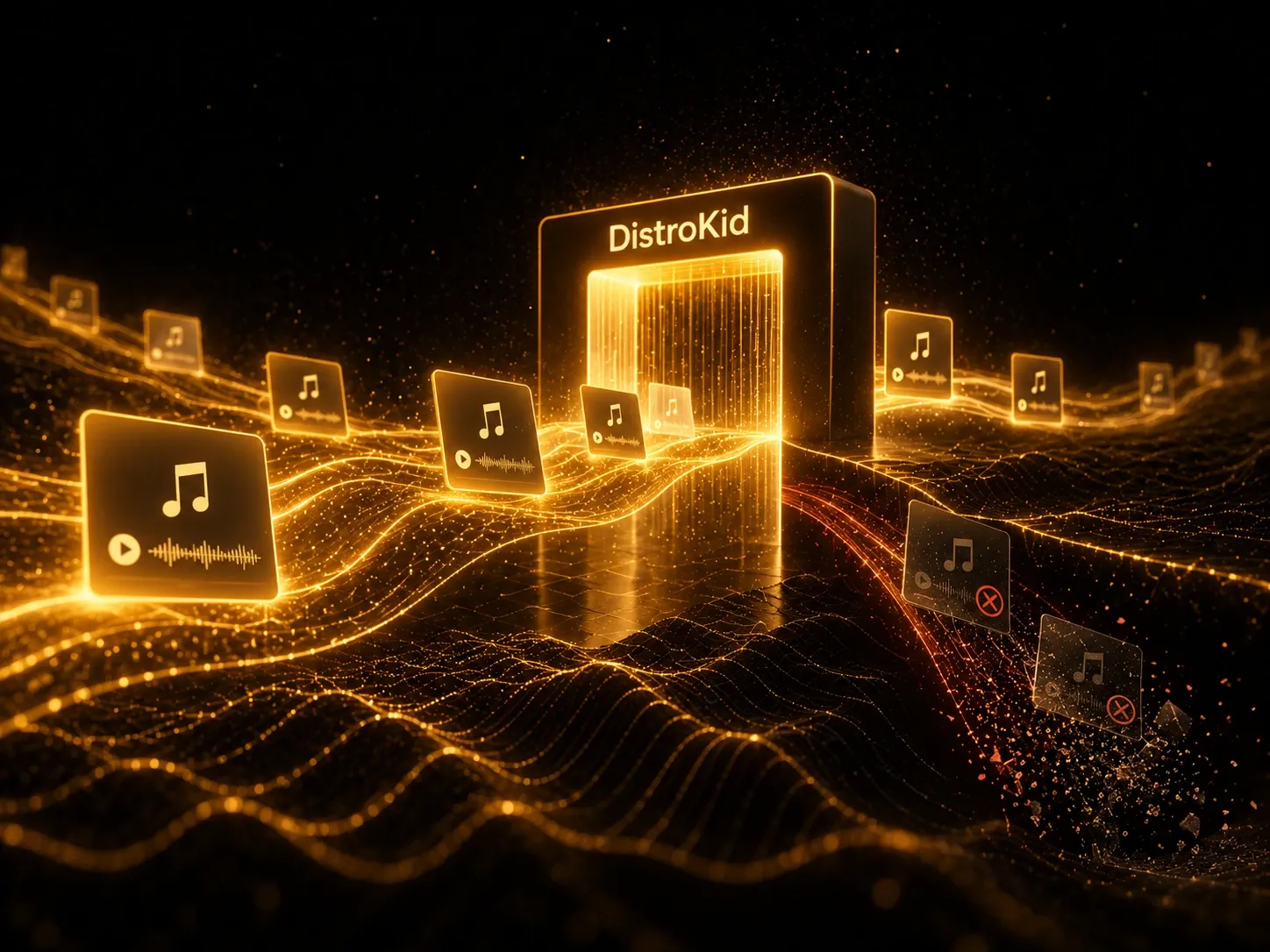
For independent musicians, a distributor is supposed to be infrastructure. Upload the master, provide the metadata, and the distributor carries the release into Spotify, Apple Music and the rest of the streaming economy.
Recent complaints around DistroKid show how much power now sits inside that middle layer. In one widely shared Instagram post, an independent artist said DistroKid removed three entire albums after three songs were flagged for alleged sampling violations. The artist said there was no warning or opportunity to resolve the claims before the releases disappeared.
The case is not isolated. The Verge reported on October 10 that artists including McGwire, Insane Ian and King Chase had music removed without prior notice, including recordings they say were original or properly licensed. DistroKid's vice president of Artist Services, Amanda Ferri, told the publication that "a very small number of recordings" had been removed in response to claims from Universal Music Group.
The immediate controversy is about copyright enforcement and communication. The larger question is what happens when an industry facing a rapid increase in music supply also has to automate the systems used to police it.
The removals follow a larger legal dispute
The timing is important. On September 15, Universal Music Group sued DistroKid in federal court in Delaware, accusing the distributor of copyright infringement and of distributing thousands of unauthorized or altered versions of UMG recordings alongside large volumes of AI-generated material, according to Reuters.
DistroKid disputed UMG's allegations and said it intended to defend itself. Reuters reported that UMG's complaint included allegedly unlicensed versions of recordings by artists such as The Beatles, Drake, Lady Gaga and Rihanna, as well as tracks the label says were created using generative AI.
The recent artist removals therefore sit inside a much larger conflict over who is responsible for stopping infringing material before it reaches streaming services. DistroKid told The Verge that the current removals were made in response to UMG claims, while continuing to reject the broader allegations in the lawsuit.
The unusual cases are what make artists nervous
Several of the reported examples are difficult to reconcile from the outside. McGwire told The Verge that six of his songs were removed, including a Stevie Wonder cover he says was properly licensed and another track built on a beat purchased through a marketplace that other artists could also license.
He also said one song was removed for allegedly containing an uncleared sample from a recording released two years after his own track. Insane Ian said an original song disappeared without warning, while King Chase said an album that had been live for three to four years was removed without prior copyright strikes or an explanation.
These accounts are artist claims, not final legal findings. They nevertheless show why transparency becomes important when enforcement happens at scale, especially when the creator cannot easily see what material matched, how strong the match was, or what evidence would resolve the dispute.
Why one disputed song can affect a whole release
DistroKid's own release architecture can make album-level disputes particularly disruptive. Its help documentation says individual tracks cannot normally be added to or removed from an album after upload. If one track needs to be removed, the standard process is to delete the release and upload a new version without that song.
That does not prove why any specific album in the current controversy was removed. It does show that DistroKid treats an album as a tightly bound release object, rather than something where one track can simply be detached after delivery.
For independent musicians, that makes a copyright dispute larger than the disappearance of one audio file. A release can carry years of streaming history, playlist placements, links, metadata and audience recognition.
Copyright detection is already highly automated
The concern that automated systems may be involved in music enforcement is not speculative in the broader sense. DistroKid announced a partnership with Audible Magic in 2019 to screen uploads against a registry containing more than 20 million media assets before distribution.
DistroKid also operates DistroLock, which creates an acoustic fingerprint of a recording. DistroKid says fingerprinting services can still detect matches after audio has been sped up, pitch-shifted or otherwise altered.
Commercial systems now advertise even more aggressive matching capabilities. Pex says its technology can identify copyrighted works from clips as short as one second, including after speed changes, pitch changes, mashups or multitrack mixing. The company also offers separate technology for detecting AI-generated songs and identifying the model family that likely produced them.
There is no public evidence showing that Pex, Audible Magic or any particular AI detector caused the current UMG-related DistroKid removals. What is clear is that the technical capability to screen enormous catalogs automatically already exists.
Finding a match is not the same as proving infringement
An acoustic fingerprint is very good at answering a narrow question. It can identify whether part of one recording appears inside another recording, even when that audio has been manipulated.
It cannot necessarily explain why the overlap exists. Two musicians might legally buy the same commercial loop, a producer may have permission to use a recording, or a cover may have been properly licensed.
This becomes even harder when the question moves from reused audio to a similar hook or melody. The U.S. Copyright Office treats the underlying musical work and the sound recording as separate copyright-protected works. A system can detect similarity between recordings or compositions, but deciding whether that similarity amounts to infringement requires much more context.
That is one of the central risks of automated enforcement. A machine-readable match can be evidence worth investigating without being a complete answer to who owns what or whether the use was lawful.
AI increases pressure on both sides of the system
This connects directly to a problem we explored in AI Music Is Being Squeezed From Both Ends. Generative AI lowers the cost of producing another recording, which means distributors and streaming services can face far more incoming music without gaining a comparable increase in human review capacity.
At the same time, rights holders are confronting genuine abuse. The Financial Times reported that Sony Music had requested the removal of more than 260,000 unauthorized AI-generated tracks by the end of September, including material impersonating established artists.
The industry therefore faces two problems at once. It needs to stop copied recordings, deepfakes, unauthorized samples and fraudulent mass uploads from scaling alongside generative music, while also avoiding legitimate artists being caught by increasingly aggressive enforcement systems.
The same AI revolution that makes music production scalable is pushing copyright enforcement toward greater automation.
Detection can scale faster than appeals
The emerging system creates a clear asymmetry. Software can scan large catalogs quickly, but licensing evidence, disputed ownership and ambiguous copyright questions still require context.
For a distributor facing a rights claim, leaving potentially infringing material online creates legal risk. Removing it first and allowing the artist to challenge the decision later may be safer for the company.
For the artist, the incentives run in the opposite direction. A false positive can remove years of work before the creator has had a chance to explain why the match is legitimate.
DistroKid does offer a formal process for copyright disputes. Its copyright help page says artists who believe material was removed because of a mistake or misidentification can file a DMCA-compliant counter-notice. DistroKid says it must then wait ten business days before reinstating the content or allowing it to be uploaded again, while individual streaming services can still choose not to restore it.
The current criticism is therefore not simply that an appeals mechanism does not exist. Artists interviewed by The Verge described difficulty understanding why their music had disappeared and reaching human support, while producer Jesse Cannon argued that affected musicians should have had an opportunity to challenge the claims before removal.
Payout complaints add another layer of distrust
The takedown dispute is also arriving during a period when artists have been raising separate concerns about DistroKid payouts. Some delays have straightforward explanations, and DistroKid currently says July 2026 YouTube earnings are late because YouTube has not yet delivered those payments, while other stores are unaffected.
Other cases involve artists alleging that balances or withdrawals became inaccessible during account disputes. A July complaint published by the Better Business Bureau, for example, alleges that $13,680.41 in previously reported earnings became inaccessible after a returned payout and subsequent account restrictions. Other BBB complaints published during 2026 make similar allegations about delayed or inaccessible withdrawals.
Those complaints are allegations from customers rather than findings that DistroKid improperly withheld royalties. There is also no clear evidence that the current UMG-related takedowns and the payout complaints are part of one coordinated enforcement program.
DistroKid's published policy says artists should still receive legitimate earnings generated while a deleted release was live. Its earnings documentation says those amounts should continue to be passed through to the artist's DistroKid Bank.
Even when the issues are technically separate, they contribute to the same trust problem. When one company sits between an independent musician and both their catalog and their royalty payments, unclear account decisions can have consequences well beyond an ordinary software dispute.
Private equity is now part of the backdrop
The controversy is also unfolding during an ownership transition. In July, private equity firm CVC Capital Partners announced that it had signed a definitive agreement to make a majority investment in DistroKid through CVC Capital Partners IX, with longtime investor Insight Partners retaining a significant minority stake, according to CVC's announcement.
The deal was announced as expected to close in the third quarter of 2026, subject to customary conditions. I could not find a subsequent public closing announcement, so it is more accurate to describe CVC as having agreed to take majority control rather than assume the transaction has formally closed.
The ownership change should not be used as an explanation for the current takedowns without evidence. There is no public indication that CVC ordered these removals, changed DistroKid's copyright policies or directed the company to reduce human review.
It is still relevant context because of DistroKid's scale. Music Week reported DistroKid's claim that it distributes roughly 40 percent of all new music worldwide, meaning decisions about support, copyright review and account enforcement can affect a significant part of the independent music ecosystem.
Independent distribution is becoming active gatekeeping
The traditional image of a distributor is a pipe between the artist and the streaming platform. That description is becoming less accurate as distributors increasingly sit inside systems for copyright identification, artificial-stream detection, metadata enforcement, artist verification and royalty administration.
Our earlier article AI Music Is Being Squeezed From Both Ends argued that distribution was becoming another filter in the AI music supply chain. The current DistroKid dispute shows what that filtering role can look like when legal pressure increases.
The distributor is no longer only checking whether an artist has supplied the correct files and metadata. It can become one of the institutions deciding whether a recording reaches the commercial music economy at all.
The new bottleneck may be due process
None of this removes the need for automated copyright enforcement. The amount of music entering digital platforms makes manual review at the upload stage increasingly unrealistic, while generative AI is making the volume problem larger.
Rights holders also have legitimate reasons to seek stronger protection against unauthorized samples, impersonation, altered recordings and fraudulent mass uploads. The danger appears when detection and judgment are allowed to become the same process.
A fingerprint match is evidence worth examining. It is not necessarily a complete account of who licensed what, who owns what, or whether infringement actually occurred.
The music industry may therefore be entering a period where identifying a possible copyright conflict takes seconds while resolving it takes days or weeks. For independent artists, that gap can determine whether an established release remains available while the question is being answered.
AI has made music generation scalable. It is now helping make music detection and enforcement scalable as well.
The harder problem is building review and appeals systems that can scale with both. If the industry gets that part wrong, one consequence of the AI music boom may not only be how much questionable material gets uploaded, but how many legitimate songs get caught while the industry tries to stop it.