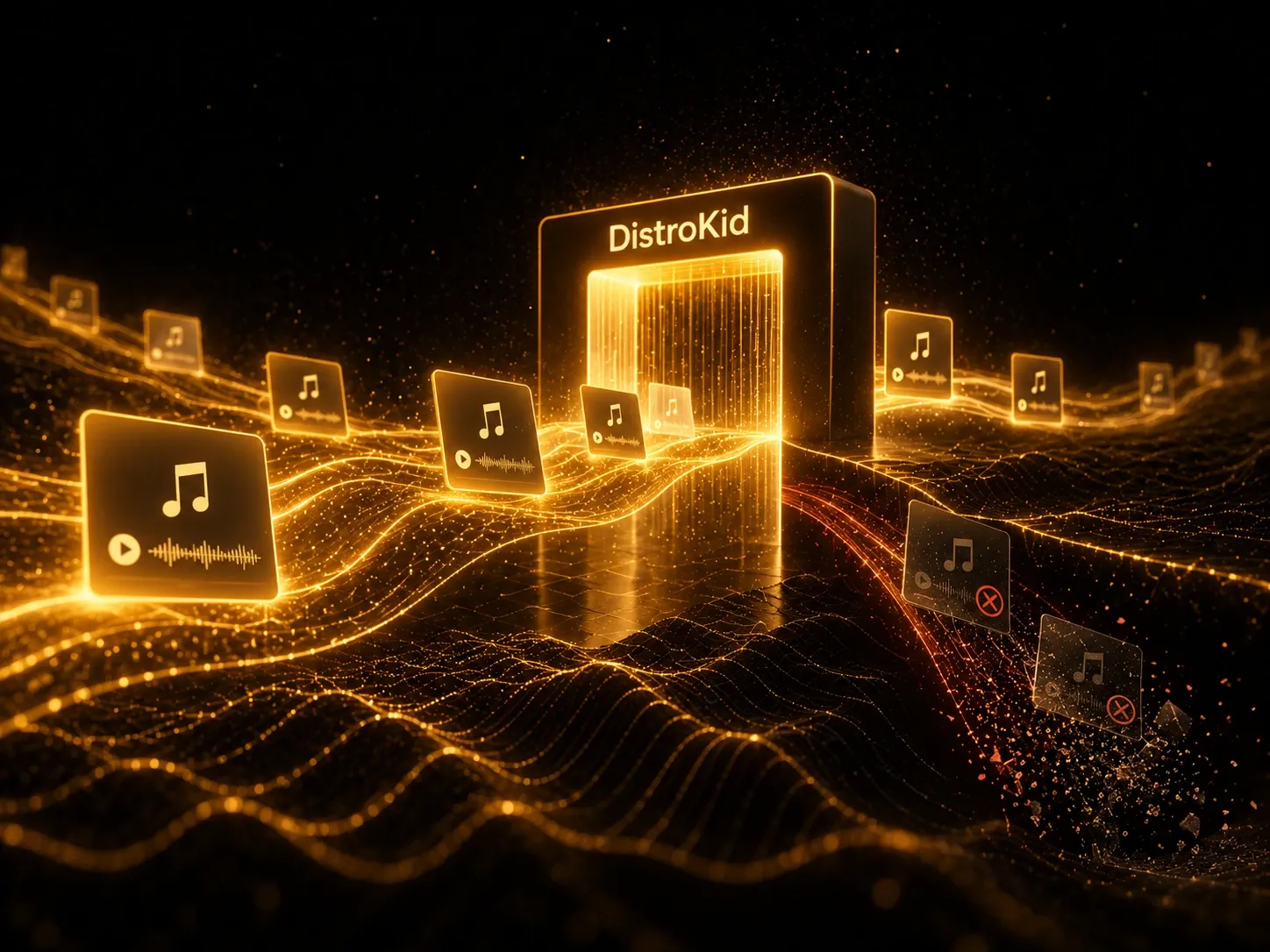
CVC Capital Partners agreed in July 2026 to make a majority investment in DistroKid through CVC Capital Partners IX. Insight Partners will retain a significant minority stake, DistroKid’s existing leadership team remains in place, and financial terms were not disclosed, according to CVC’s announcement.
That matters, but not because artists should assume immediate disruption. There is currently no evidence that the transaction has caused royalty cuts, new upload limits, or new AI restrictions. The better question is slower and more structural. What happens when one of the key pipes used by independent artists, including AI artists, becomes controlled by a private equity owner at the same moment that AI is changing the cost, volume, and verification burden of recorded music.
For artists and listeners, distribution can feel invisible until something breaks. A distributor is the route between a creator’s files and services such as Spotify, Apple Music, YouTube Music, and Deezer. It also handles metadata, payouts, takedowns, and increasingly, compliance signals. In the AI era, those back office functions are moving closer to the center of the music economy.
CVC does not need to take royalties to raise revenue
DistroKid’s current artist proposition is clear. It says it offers unlimited distribution under its subscription plans, and that artists keep 100% of the earnings DistroKid receives from streaming services and stores, subject to applicable fees and taxes. DistroKid explains that model in its support pages on what the service does and how much of earnings it keeps.
That headline does not have to disappear for a new owner to seek higher revenue per user. Growth could come from subscription pricing, premium features, paid extras, analytics, rights tools, promotion products, verification services, or other creator infrastructure. That is editorial analysis, not an announced CVC strategy. The point is that the royalty percentage is only one part of the business model.
DistroKid also has real switching friction. Its support documentation says releases can be removed from streaming services after a subscription ends unless the relevant release has Leave a Legacy, a paid option designed to keep music live after cancellation or non-renewal. That policy is described in DistroKid’s page on what happens if a subscription is not renewed.
This does not make DistroKid unusual in having business rules. It does mean catalog portability is not frictionless. For a human band with one album, that may be manageable. For an AI artist running multiple aliases, hundreds of tracks, and detailed prompt, rights, and metadata records, switching distributors can become a meaningful operational project.
AI changes the economics of unlimited uploads
DistroKid explicitly allows music made with AI tools, provided uploaders hold the necessary rights and avoid unauthorized impersonation, infringement, and mass-generated spam intended to manipulate platforms, according to its support page on uploading music made with AI tools. It also lists unlimited song uploads among plan features in its plan comparison support page.
Those two facts become more important together than apart. Unlimited distribution was built for an era when most artists still faced high creative, recording, mixing, artwork, and release-planning costs. AI lowers some of those costs, especially for high-volume producers who can generate instrumentals, variations, demos, vocals, or full tracks at speed.
Deezer’s reporting shows how quickly the volume problem can scale. In July 2026, Deezer said it was receiving around 90,000 fully AI-generated tracks per day, with AI tracks exceeding 50% of daily new uploads at peak periods, according to its newsroom post on AI music upload volumes.
That creates an unlimited uploads paradox. A conventional musician may release 10 or 20 tracks a year. An AI-native producer can potentially generate hundreds. The marginal cost of creating more music falls, while the cost of checking rights, detecting spam, reviewing metadata, responding to platform flags, and preventing fraudulent activity may rise.
For legitimate AI creators, this is not a reason to treat volume as suspicious by default. Some artists work in libraries, functional music, microgenres, game soundtracks, sound design, or experimental releases where scale is part of the practice. But it does mean distributors will face pressure to distinguish productive abundance from low-value flooding.
Distribution is becoming compliance infrastructure
DistroKid has already moved beyond simple file delivery in how it handles AI information. Its AI Credits feature allows artists to disclose whether AI generated lyrics, compositions, vocals, or other parts of a recording, according to DistroKid’s support page on AI Credits.
That kind of disclosure matters because platforms are trying to understand what they are hosting and monetizing. Spotify says it can charge labels and distributors when flagrant artificial streaming is detected on tracks in their catalog, as described in its guidance on artificial streaming. The commercial risk can therefore sit upstream with the distributor, not only with the artist who uploaded the track.
The distributor is becoming part of music’s identity, provenance, and compliance infrastructure. It may need to know who the artist is, whether AI was used, whether a voice resembles someone else, whether the uploader has commercial rights from an AI tool, whether metadata is accurate, and whether streaming behavior looks manipulated.
That shift matters to listeners because catalog quality depends on trust. It matters to creators because access to distribution can shape whether their work is heard at all. It matters to AI artists because the legitimacy of their work may increasingly depend on records, disclosures, and rights documentation, not only on the sound of the finished track.
The plausible futures are not identical
One possible future is stricter distribution. DistroKid or similar services could introduce stronger verification, tougher spam detection, differentiated pricing for very high-volume users, or more detailed AI disclosure workflows. Another possible future is more expansive. AI could create millions of new customers who need distribution, rights management, analytics, monetization, catalog organization, and identity tools.
Neither outcome has been announced by CVC or DistroKid. The investment should not be read as proof that restrictions are coming, or that the current subscription model is about to change. The evidence supports a narrower conclusion. CVC is taking majority control while AI is making distribution both more valuable and more complicated.
For now, artists do not need to panic or migrate catalogs simply because ownership has changed. They should act like professionals managing durable assets. Keep independent copies of masters, artwork, lyrics, metadata, ISRCs, royalty statements, release dates, ownership splits, and takedown records. AI artists should also retain records of the tools they used, the dates they used them, the prompts or workflow notes they can reasonably preserve, and the commercial rights those tools granted at the time.
The important question is not whether private equity immediately makes DistroKid worse. It is what happens when the pipes of independent music increasingly become its gates. In that world, creators who understand distribution, documentation, and platform incentives will be better prepared than those who treat upload buttons as neutral infrastructure.