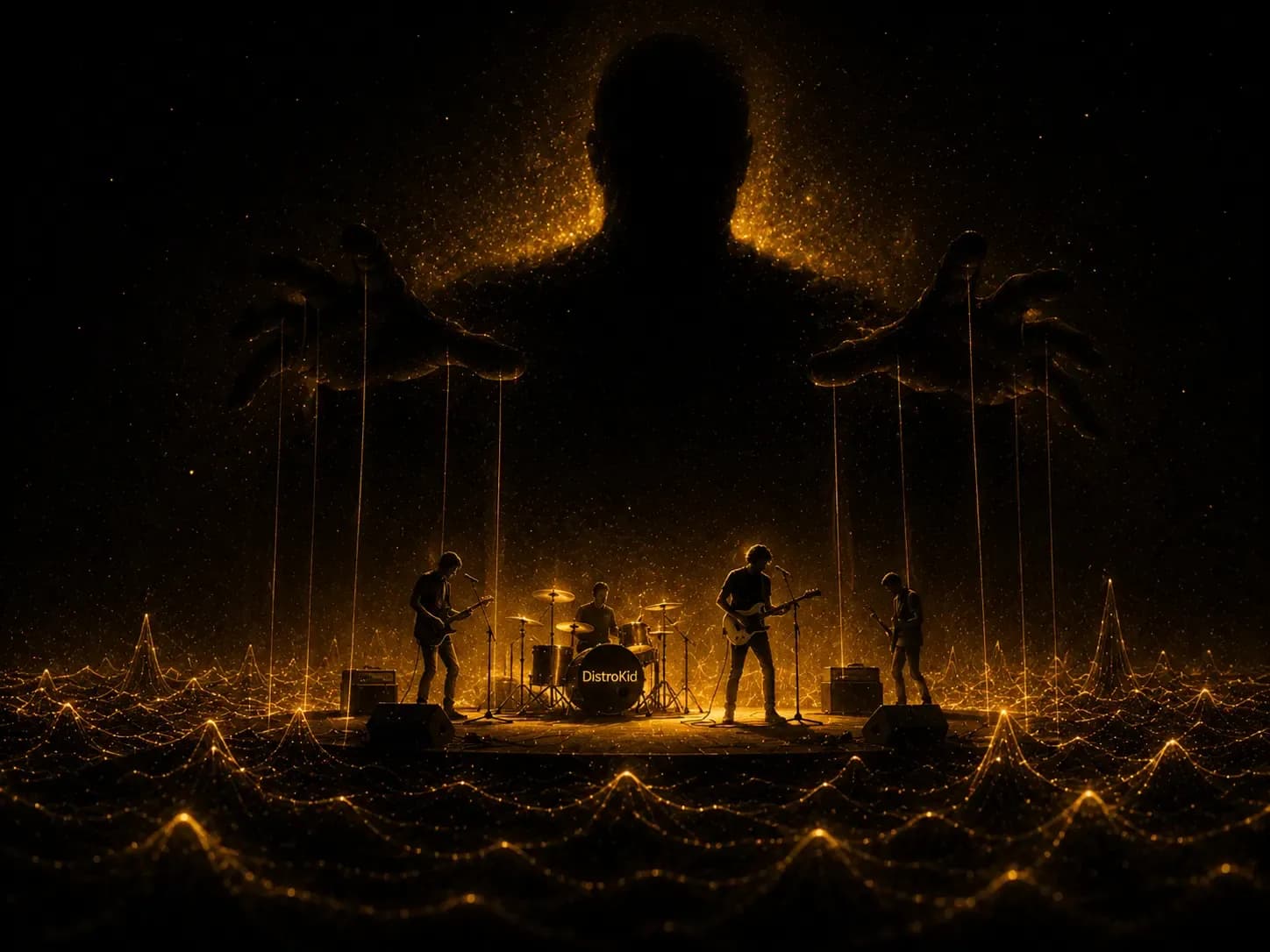
In 2025, Lunar Boom compared lab-grown diamonds with AI music and natural diamonds with human-made music. The argument in What the Diamond Industry Can Tell Us About the Future of AI Music was not that one was real and the other fake. It was that one would become cheap, scalable and useful, while the other would retain value through story, identity, scarcity and cultural meaning.
That analogy still works. It now needs sharpening.
The diamond industry shows what happens when technology removes scarcity from production. Value migrates toward whatever remains scarce. In music, that increasingly means attention, identity, trust, cultural relevance, distribution and rights.
The production premium is disappearing
Lab-grown diamonds did not fail because they were technically inferior. They became less valuable as production scaled and supply expanded. Once a product can be manufactured in large quantities with consistent quality, the market stops rewarding the act of making another unit as generously as before.
AI music is moving through the same supply shock. Deezer has said it receives tens of thousands of fully AI-generated tracks per day. That number matters less as a spectacle than as a market signal. The bottleneck in recorded music is no longer whether a track can be made. It is whether anyone wants to hear it, trust it, share it, license it or build identity around it.
This is not an argument against AI music. Lunar Boom exists because AI can open musical creation to more people, expand genre exploration and make royalty-free music more accessible to creators. But abundance changes the economics of music creation. If millions of tracks can be generated quickly, the act of generation itself becomes a weaker claim to value.
The mistake is to assume that because human-made music is less scalable, it is automatically the natural diamond of the market. It is not. A song made by a human with no audience, no context and no demand is still competing for attention in an over-supplied environment. Human labor alone does not create scarcity if the listener has no reason to care.
Scarcity has moved away from the file
The musical equivalent of a natural diamond is not simply a song made by a person. It is a song connected to meaning, identity and demand.
That distinction matters for musicians, AI artists and listeners. A recording has technical properties, but music also functions as a social object. People use it to remember places, signal taste, follow artists, participate in scenes and attach sound to personal history. Those forms of value are harder to mass-produce than audio files.
This is where the diamond analogy becomes more useful than a simple human versus machine debate. Natural diamonds are sold not only as stones, but as origin, certification, rarity and symbolism. Music is moving toward a similar split. The sound will still matter, but so will the story of who made it, which tools were used, who owns the rights and whether a real audience has gathered around it.
For AI music, this creates both opportunity and pressure. AI artists will need more than output volume. They will need recognizable creative direction, transparent positioning and reasons for listeners to return. For human musicians, the lesson is equally demanding. Being human is not enough. The scarce asset is the relationship between artist, work and audience.
Platforms are rebuilding scarcity through access
AI removed scarcity from production, but platforms can reintroduce scarcity through discovery. Deezer’s decision to exclude detected AI music from recommendations is one example. Even if a track can be uploaded, that does not mean it will be distributed into meaningful listening contexts.
This is the new gatekeeping layer. Scarcity is shifting from the studio to the recommendation system. Access to playlists, search visibility, algorithmic radio, editorial features and trusted catalogues may become more important than the ability to create a track in the first place.
Listeners are also asking for control. The Nordic Digital Music Survey 2026 reported that 77 percent of surveyed consumers wanted AI-generated music clearly labelled, while 74 percent wanted the option to filter it out of playlists, according to CISAC. Those figures do not prove listeners will reject AI music. They do show that many want context and choice.
That is a trust issue, not just a labelling issue. If listeners cannot tell what they are hearing, platforms may respond by creating new signals of reliability. Labels, filters and recommendation rules become a form of market structure. They decide which abundance becomes visible.
The old industry is joining the AI side
The 2025 version of the analogy suggested a cleaner division between AI music and human music. That division is now less convincing. Major rights holders are not simply defending the old market from the outside. They are beginning to build AI into it.
Universal Music Group and ElevenLabs have announced a multi-year strategic agreement for a licensed AI music creation platform, allowing fan co-creation around participating artists and songwriters, with an emphasis on rights management and compensation, according to Universal Music Group. Music Business Worldwide reported that the deal is ElevenLabs’ first with a major music company and frames it around new fan engagement models, as covered by Music Business Worldwide.
That matters because it suggests AI may become infrastructure inside the music business rather than a separate rival industry. The same companies that own catalogues, manage artists and influence distribution may also license AI creation tools, approve remix environments and define the terms under which synthetic music enters the market.
The rights questions remain unsettled. The Verge reported that Suno admitted in a court filing that it used audio scraped from YouTube as training data, specifically mentioning YT-DLP, in coverage by The Verge. Separately, the American Federation of Musicians has challenged Universal and Warner in litigation over allegations that members’ recordings were fed into AI systems for commercial exploitation without compensation, as reported by Music Business Worldwide.
These disputes underline the same point. In an abundant market, provenance becomes part of the product. The question is not only whether something sounds good. It is who made it, whose work helped train or shape it, which rights were cleared and who benefits.
Human-made becomes a provenance claim
As AI systems improve, sound alone may become a weaker way to classify music. The more important question may be how the work came into being. A track could involve a human songwriter, an AI-generated arrangement, a cloned or synthetic vocal, manual editing, licensed source material and platform-level moderation. A simple AI or not AI label may not capture that reality.
This is where human-made may become a provenance label. It will not be valuable by default, but it may matter when attached to artists, scenes and communities that listeners trust. For AI music, transparent provenance can also create value. A clearly disclosed AI artist with a consistent creative identity may earn more trust than a track designed to hide its origins.
The updated diamond lesson is therefore not that human music wins and AI music loses. Both can still shine. The sharper question is what remains valuable once anyone can manufacture the sparkle.