Music catalogues are priced on expectations. A buyer is not only purchasing past success, they are paying for future cash flows from streaming, radio, performance royalties, sync placements and licensing. For years, the strongest argument behind catalogue valuations was that proven songs were scarce. Hits were hard to make, rights were hard to assemble, and streaming promised long duration revenue from listening that could continue for decades.
AI does not erase that logic, but it does challenge part of it. Commercially usable music is becoming faster and cheaper to produce, especially in areas where the listener is not searching for a named artist or a culturally specific song. Background music, production-library tracks, mood-based playlists and low-attention sync uses are the obvious pressure points. If supply grows faster than attention and licensing demand, buyers should demand higher yields, apply lower multiples, or both.
That is the central question for catalogue investors and rights holders. Are some assets still priced as if recorded music were scarcer than it is becoming?
What the ANote Music Index is showing
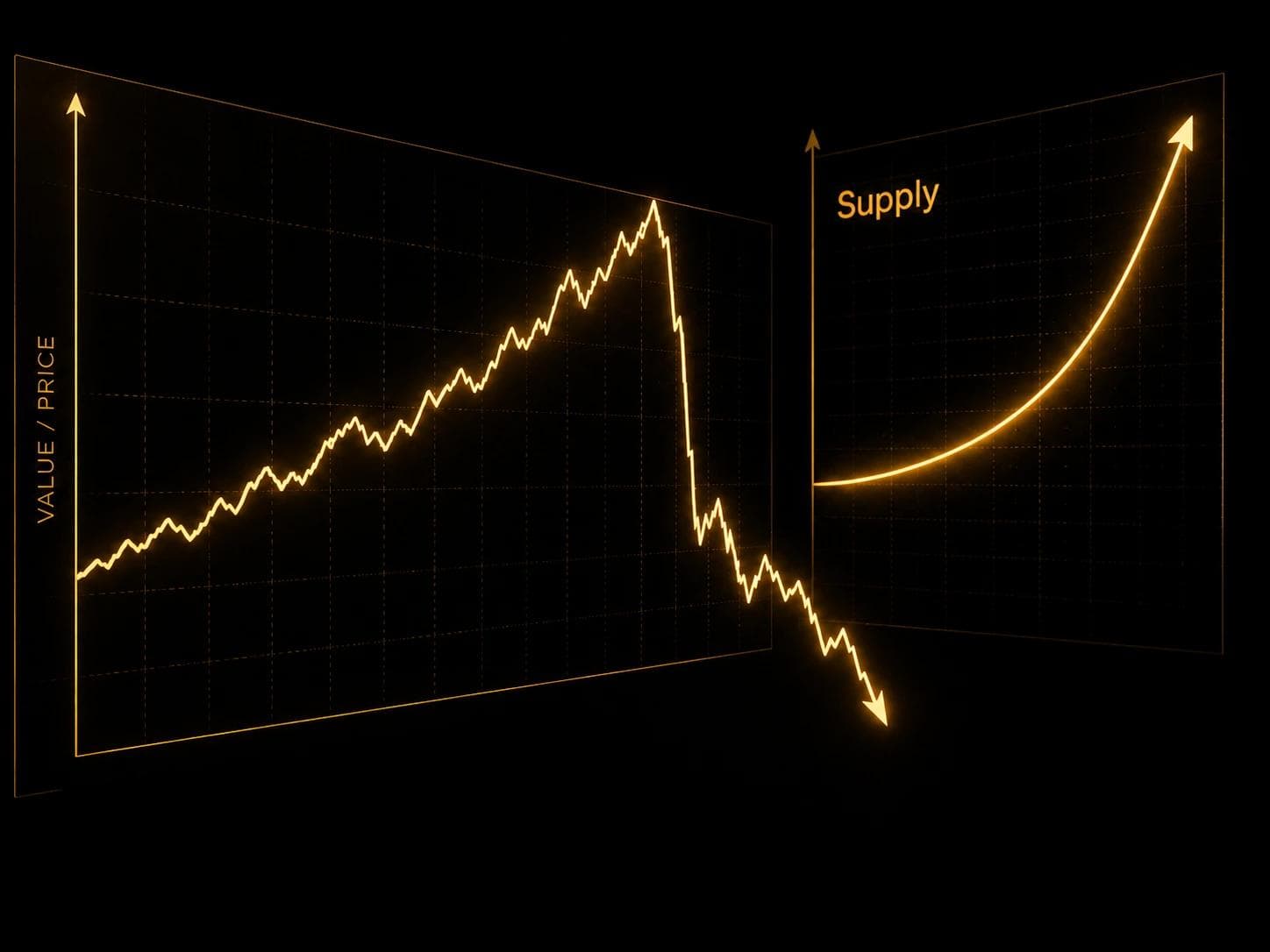
The ANote Music Index is a useful case study because it tracks price movements and reinvested royalties across catalogues listed on the ANote marketplace. According to ANote Music, the index stands at €1,658.25, with an annualized IRR of 9.15%. The chart rose from around 1,000 in 2020 to a visible peak near 1,950 in 2025, before falling by roughly 15%.
That decline matters because the index is not only a price chart. Since it includes reinvested royalties, recent weakness suggests that total returns across the marketplace have softened, not merely that quoted catalogue prices have moved around. It may indicate repricing. It does not prove AI caused the fall. Interest rates, investor appetite, catalogue mix, individual royalty performance and broader music-market expectations could all contribute.
Still, the timing is hard to ignore. Catalogue values are being reassessed just as the market is absorbing a structural change in music supply. The prudent reading is not that AI has already broken catalogue economics. It is that investors are beginning to require more evidence before paying premium prices for music income.
Current ANote listings show that required yields vary meaningfully. Andreas Öberg is listed at €10 per share, with historical annual yield shown between 11.46% and 18.12%. Sundance Music is listed at €14.17, with 9.4% to 9.5%. Dante Klein is listed at €14.97, with 10.6% to 13.81%. Cadillac Records is listed at €26.99, with 8.17% to 8.72%. Gaullin is listed at €17.85, with 11.98% to 13.94%. Peter Hanna is listed at €23.20, with 10.02% to 11.91%.
Those figures should not be read as a simple ranking of quality. A higher historical yield can mean better income, but it can also mean greater perceived risk, less predictable royalty flow, weaker liquidity, or lower confidence in future durability. The right comparison is more granular. What rights are being sold, and how stable are the royalty sources? Is the catalogue tied to a recognizable artist or mainly to functional listening? Does the music have cultural memory, fan demand and repeat discovery, or is it closer to interchangeable background use? Those questions are becoming more important than the headline yield.
The supply evidence is no longer theoretical
The wider market supports the idea that supply is expanding faster than attention. Music Business Worldwide reported that streaming services held 253 million tracks at the end of 2025, up 37.9 million in one year, which equals about 106,000 additions per day. Almost half received fewer than ten streams, according to the same report, which shows how much of the catalogue universe is barely finding an audience Music Business Worldwide.
That does not mean new music has no value. Lunar Boom exists because AI can help creators explore genres, produce original music and make usable tracks available at scale. But scale changes the economics of attention. When the number of available tracks rises far faster than listening time, discovery becomes the scarce asset. The market stops rewarding mere availability and rewards recognizability, placement, trust and context.
Deezer’s own data points in the same direction. The company reported around 90,000 fully AI-generated uploads per day at the June 2026 peak, more than half of new deliveries Deezer Newsroom. For listeners, that raises questions about navigation and quality control. For musicians and AI artists, it raises a more commercial question. If platforms receive tens of thousands of AI tracks daily, what makes a particular catalogue defensible?
A CISAC-commissioned forecast goes further. It estimates that by 2028 AI music could represent 20% of streaming-platform revenue and 60% of music-library revenue, while putting 24% of creators’ revenue at risk CISAC. Forecasts are not facts about the future, and they depend on assumptions. Even so, the direction of concern is clear. Library music is more exposed because buyers often need a mood, tempo or function rather than a famous recording.
The premium should move toward scarcity that still exists
The likely outcome is not a uniform collapse in catalogue values. It is a sharper distinction between catalogues. Music tied to recognizable artists, durable fandom, cultural events, strong songwriting identities or enduring sync relevance remains scarce in a way that generic supply does not easily replicate. A beloved recording is not just audio. It carries memory, association, trust and social proof.
By contrast, interchangeable functional music faces a tougher valuation environment. If a buyer needs calm background audio, corporate underscore, workout intensity or neutral production music, AI can create plausible substitutes quickly. That does not eliminate human-made or AI-assisted catalogues, but it reduces pricing power where the main value is utility rather than identity.
For rights holders, the lesson is to document durability. Stable royalty history, diversified income sources, identifiable demand and low dependence on replaceable use cases should command more confidence. For creators and AI artists, the lesson is not to flood platforms and hope scale solves distribution. The more music supply expands, the more important curation, brand, metadata, community and rights clarity become.
The ANote Music Index does not answer whether AI caused recent catalogue weakness. It does show that music income assets can reprice even when royalties are included in return calculations. Combined with the growth in total tracks, the surge in AI uploads and the forecasts for library revenue displacement, it points to a more demanding market.
Music may still deserve a premium. The question is which music. Catalogue buyers should be more skeptical of scarcity stories attached to assets that AI can approximate in volume. The premium belongs where scarcity is still real, in songs, artists and rights that listeners and licensees seek out because substitution would change the value of the use itself.