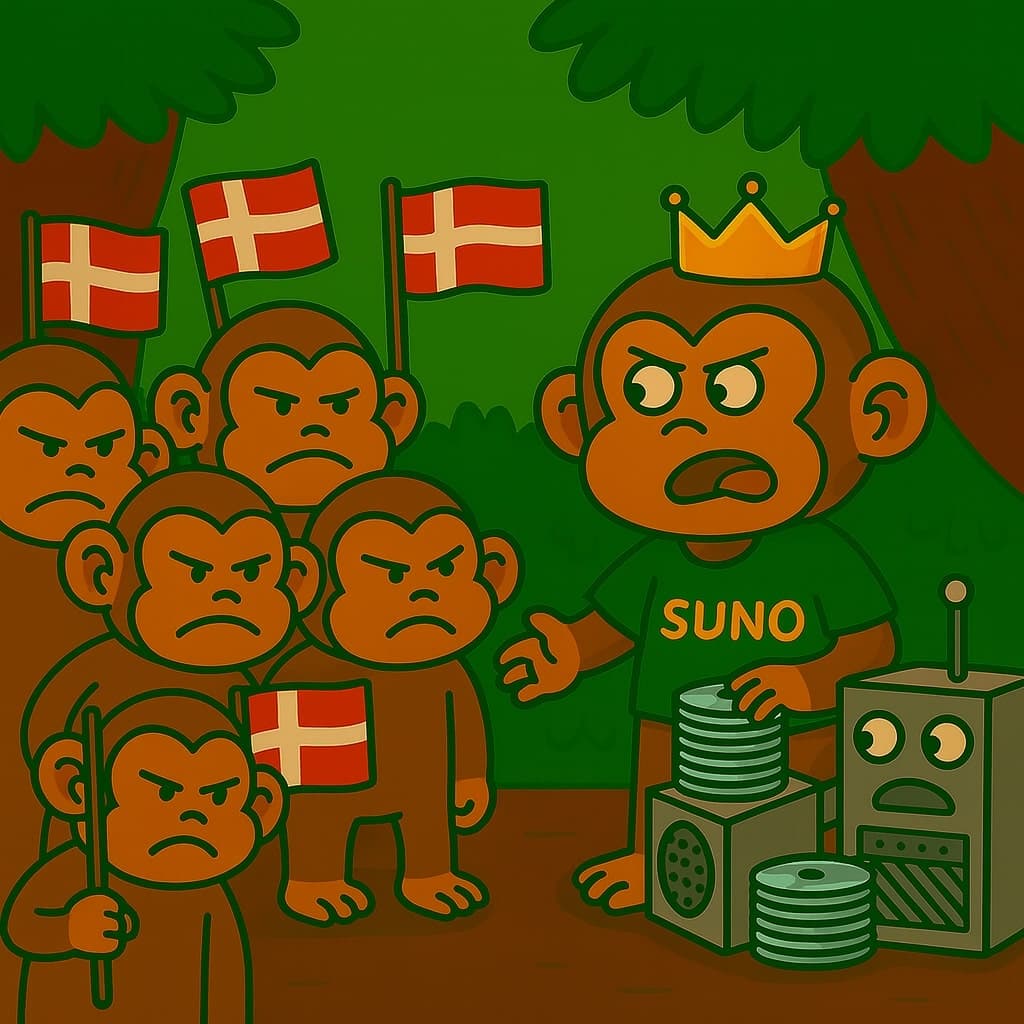
Denmark's music rights organization Koda sued Suno over allegations that copyrighted Danish songs were used without permission to train its AI and that generated outputs infringed protected music. The case was filed in Copenhagen and puts both training data and output similarity into the same dispute.
Koda challenged training and generated outputs
Koda filed the case with the Copenhagen City Court and asked for it to be referred to a higher court because of its significance.
Koda alleges that Suno violated Denmark's Copyright Act by copying protected music during training and by making infringing material available through generated outputs. It also raised concerns about market dilution and stream ripping.
These are Koda's allegations. They are not a final court finding.
Original reporting on the case is available from Digital Music News.
Koda named four Danish songs
Koda said Suno produced outputs resembling several well-known tracks.
- Barbie Girl by Aqua
- Final Song by MØ
- A Beautiful Life by Christopher
- Sleeping My Day Away by D.A.D.
Koda argues that these examples support its claim that the original works were present in Suno's training material.
Its CEO Gorm Arildsen framed the case in unusually direct language.
“We are excited about what responsible AI can do for music. But innovation can’t be built on stolen goods. Suno has taken our members’ creative work… without consent, transparency or remuneration. That is theft – and it threatens the future of music.”
The word theft here is Koda's characterization of the alleged conduct, not an independent legal conclusion.
The case tests two separate copyright questions
The first question is whether copyrighted music can be copied or processed for AI training without permission. The second is how courts should treat generated music that resembles a protected work.
Those questions do not necessarily receive the same answer.
The lawsuit also arrived while Suno was reportedly pursuing a $100 million funding round at a $2 billion valuation, covered in Lunar Boom's earlier report.
At the same time, Udio was moving toward major-label partnerships. That contrast shows why the industry was beginning to explore licensing at the same time it continued litigating over earlier AI training practices.
You can read the full Digital Music News report for the original coverage.