Lunar Boom Learning
Chapter 5
Chapter 5
Evaluating, Releasing, and Governing the Model
From measuring generated music to responsible deployment, provenance, and future capabilities
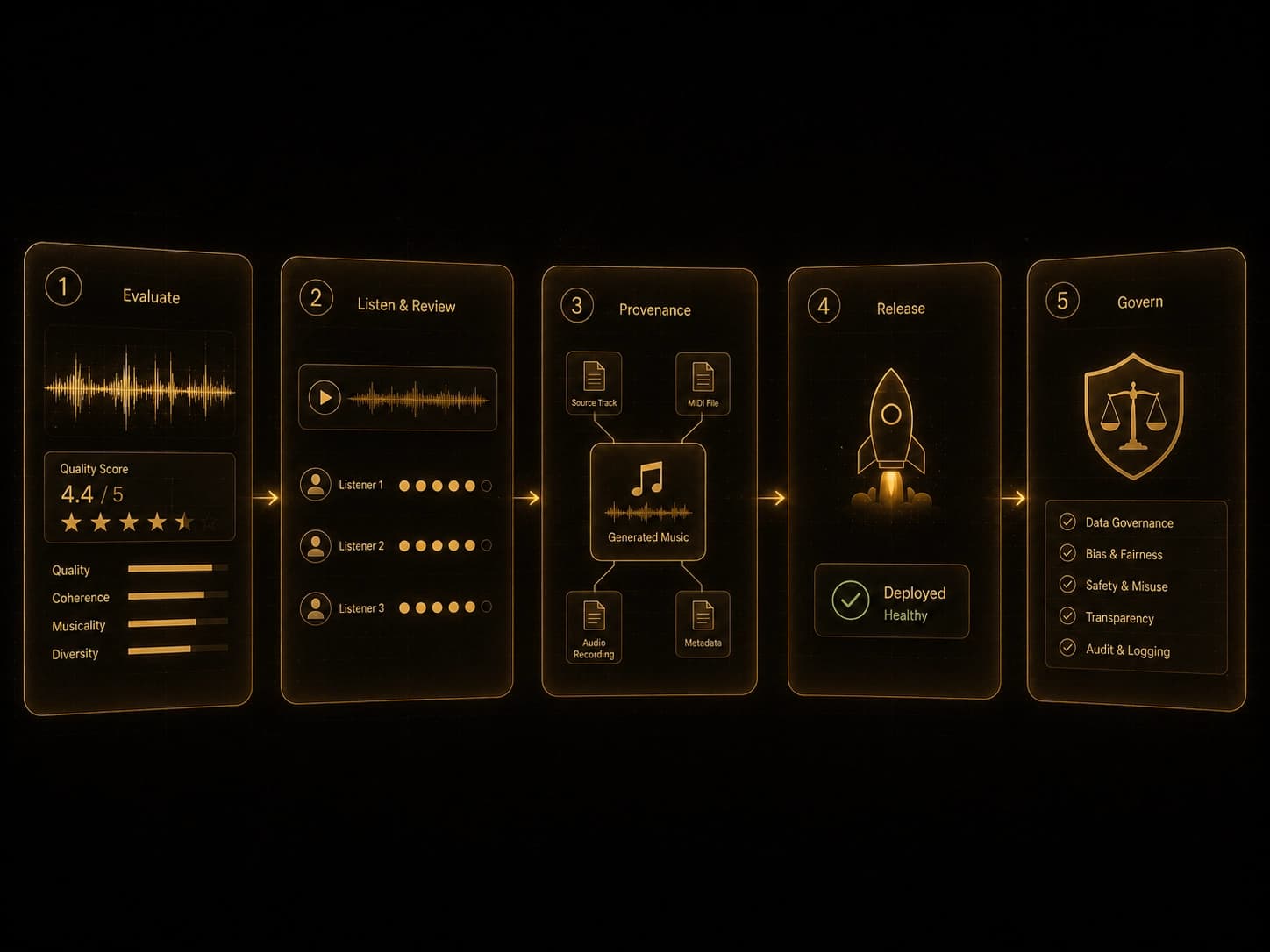
The final chapter moves from model development to judgment, release, and responsibility. It explains how to define music quality, measure selected properties automatically, run controlled listening studies, investigate source relationships, preserve provenance, operate a dependable product, and evaluate future capabilities without overstating what current systems can do.
What you’ll learn
- Separate audio fidelity, local and global musical coherence, prompt adherence, diversity, originality, editability, reliability, and usefulness.
- Build task-specific evaluation rubrics using dimensions, rating anchors, mandatory gates, representative prompts, and documented decision rules.
- Select and interpret automated measures for audio-text alignment, distributional similarity, reconstruction, diversity, musical structure, stability, and replication risk.
- Design blind human listening tests that control loudness, order, listener groups, rating scales, response quality, uncertainty, and participant protections.
- Distinguish broad style resemblance from recording, melodic, lyrical, and vocal-identity similarity.
- Test possible memorization using known training examples, held-out controls, windowed retrieval, complementary similarity methods, and aligned human review.
- Explain the roles and limitations of watermarks, Content Credentials, generation manifests, model cards, and dataset datasheets.
- Trace a generation request through validation, prompt processing, queues, GPU inference, output checks, storage, delivery, observability, feedback, and cost allocation.
- Design versioning, rollout, rollback, moderation, retention, incident-response, and unit-economics controls for an AI music product.
- Separate capabilities already demonstrated from emerging integrations and longer-term possibilities, then identify the technical and governance requirements behind each direction.
Questions to carry with you
What does it mean for generated music to be good for a particular user and task?
Which properties can automated metrics measure, and where do their assumptions fail?
When are human listeners necessary, and how should listening studies be controlled?
How can style resemblance be separated from source-specific reproduction?
What evidence supports a claim of memorization, training-set membership, or replication?
What should provenance, attribution, model, and dataset documentation disclose?
What infrastructure must surround a trained model before it becomes a dependable product?
How should product teams balance latency, reliability, safety, output quality, and cost?
Which future AI music capabilities are already demonstrated, emerging, or still speculative?
What should remain under meaningful human control as AI music systems become more capable?
Sections
Section 5.1 · 16 min
What Makes Generated Music Good?
Learn how to evaluate generated music across audio fidelity, musical coherence, condition adherence, diversity, originality, editability, reliability, and usefulness for a specific application.
Section 5.2 · 16 min
Automated Evaluation
Learn how automated systems measure selected properties of generated music using audio-text embeddings, distributional distances, reconstruction metrics, musical descriptors, diversity tests, stability checks, and replication searches.
Section 5.3 · 16 min
Human Listening Tests
Learn how to design controlled listening studies using blind presentation, task-specific questions, rating anchors, paired comparisons, representative listener groups, loudness control, randomisation, quality checks, and appropriate statistical reporting.
Section 5.4 · 18 min
Similarity, Memorisation, and Attribution
Learn how to distinguish broad stylistic resemblance from recording, melodic, lyrical, and vocal similarity, test generated outputs against training or reference collections, investigate possible memorisation, attach provenance records and watermarks, and document models and datasets transparently.
Section 5.5 · 18 min
Turning a Model Into a Product
Learn how a music model becomes a dependable product through request validation, prompt and asset processing, asynchronous scheduling, GPU inference, output checks, storage, delivery, versioning, observability, feedback, safety controls, and unit-cost management.
Section 5.6 · 18 min
Where AI Music Models Are Heading
Conclude the book by separating capabilities already demonstrated in research or products from emerging integrations and longer-term possibilities, then connect each direction to the representations, datasets, inference systems, creator controls, consent structures, evaluation methods, and provenance records it requires.
Chapter recap
Chapter takeaway
Chapter 5 completes the journey from trained model to evaluated, documented, deployed, and governed system. It begins by defining quality as a set of task-specific dimensions, converts selected dimensions into automated measurements, adds controlled human listening, investigates similarity and memorization, builds the surrounding product infrastructure, and closes by assessing where AI music systems may develop next.
Generated-music quality is multidimensional and must be defined relative to a user, task, and decision.
Mandatory release gates should be applied before weighted averages so severe failures cannot be hidden by strong scores elsewhere.
Automated metrics are operational definitions that depend on representations, reference data, preprocessing, sample selection, and implementation choices.
Human listening remains necessary for perceptual quality, musical coherence, preference, usefulness, and claims that automated measures cannot validate fully.
Listening studies require precise questions, blind presentation, order and loudness controls, suitable listener groups, predefined exclusions, and uncertainty reporting.
Similarity is not one property. Recording fingerprints, embeddings, melodic comparisons, voice models, and human review detect different relationships.
Memorization claims are strongest when known training examples are compared with matched held-out controls under explicit elicitation and similarity procedures.
Watermarks, Content Credentials, generation manifests, model cards, and dataset datasheets provide complementary forms of evidence, but none proves complete authorship, ownership, truth, or legal compliance alone.
A dependable AI music product is a versioned and observable job system surrounding inference, with queues, retries, storage, moderation, provenance, rollback, and incident response.
Product economics should include failures, retries, moderation, storage, delivery, and regeneration, not only successful GPU inference.
Future capabilities should be classified by demonstrated evidence and connected to the data, models, evaluation, infrastructure, consent, and governance they require.
Increasing model capability increases the importance of meaningful human control, transparent records, representative evaluation, and clear limits on use.
Check your understanding
Chapter 5 Assessment
Review multidimensional quality, automated metrics, controlled listening, similarity and memorization, provenance, product infrastructure, and evidence-based future capability assessment.