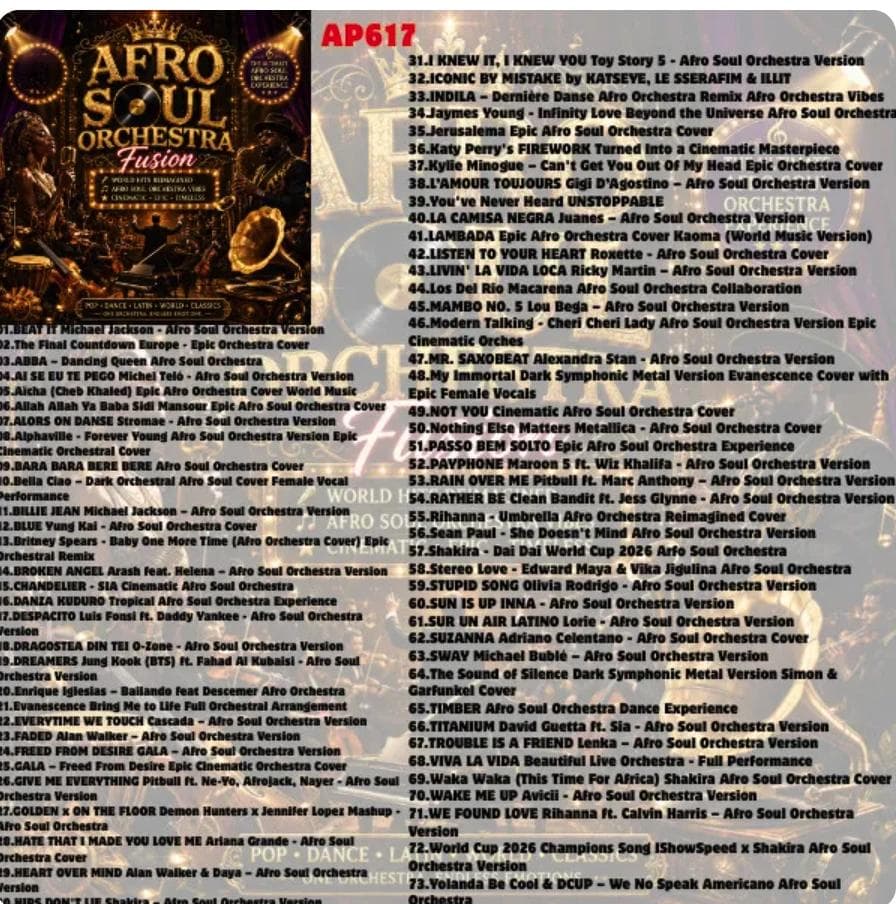
I was in a street market in Kuala Lumpur when I saw a table full of music albums on USB sticks. That was already odd enough to stop me walking.
CDs are one thing. Vinyl has had its revival, complete with ritual, dust, and people pretending not to care about surface noise. But USB stick albums felt like a format invented by someone who had skipped directly from 2006 to now to steal some bitcoin.
At first, I thought I had found a particularly stubborn form of physical media. Then I looked closer. The seller seemed to have everything imaginable. Bob Marley-style music. Spanish music. Club music. Polished-looking pop acts I had never heard of. Album covers featuring faces that had the familiar AI aspects.
The more I looked, the less it felt like a normal bootleg stall. It was not just a table of copied albums. It looked like a miniature synthetic music industry, compressed onto cheap USB sticks and laid out under market lights. At one point, I started questioning whether the seller was AI too. She did seem real, although in fairness that is exactly what an AI seller would want me to think.
The joke is obvious, but the market stall was not only funny. The remarkable part is not that somebody made AI music. That happens every day now. The remarkable part is that a physical retail market for mass-produced AI music already appears to exist.
After seeing the stall, we looked online and found similar products being sold through Malaysian e-commerce platforms. One Lazada Malaysia listing describes an AI music USB product containing AI-generated covers of famous songs rather than entirely original AI artists, which makes the situation even stranger AI music USB stick listing on Lazada Malaysia.
That distinction matters. An AI cover of a famous song is not magically outside copyright law because a machine sang it. A composition can still be protected separately from a particular recording, and a soundalike performance can raise its own questions depending on how it is made, marketed, and sold. The point is not to offer a legal verdict from a market stall. The point is that this sits in a murky space between piracy, imitation, AI generation, and licensing, and that murkiness is now being packaged as a consumer product.
So is this some strange new phase of physical music distribution? Is this the end of CDs and physical music as we know it?
Probably not. We can reconsider the question once AI-generated albums start appearing on vinyl in vintage record stores, which will probably happen sooner or later. I look forward to a collector solemnly inspecting a gatefold sleeve for an imaginary 1970s funk band whose drummer has seven fingers and no known tax history.
Underneath the absurdity, though, there is a serious economic shift. Traditionally, someone selling a bootleg USB stick filled with popular songs would need to copy copyrighted recordings. That is a familiar infringement model. The seller takes the existing good, duplicates it, and sells the duplicate.
AI changes the production economics. A seller can increasingly manufacture a substitute music product at extremely low marginal cost. Instead of copying the original recording, they can generate a nearby version of the entire package. The song style, the singer, the artist identity, the album artwork, the genre label, the nostalgic mood, and even the vague promise of familiarity can all be produced as imitation rather than direct duplication.
That is why this feels different from the old bootleg economy. It is not necessarily cleaner, more ethical, or legally safer. In some cases it may be more confusing. But it changes what the seller is selling. The product is no longer simply a stolen copy. It can be a synthetic alternative designed to satisfy the same listener impulse at a lower price.
There are at least two honest ways to look at that.
For consumers, extremely cheap access to enormous quantities of music has obvious appeal. Some of it may even sound reasonably good, especially for casual listening, background use, or novelty. The rough edges can become part of the experience. There is the occasional AI hiss, the mangled pronunciation, the strange vocal crack, or the moment where the singer appears to temporarily forget how being human works. For some buyers, that may be acceptable. For others, it may even be funny enough to become the point.
For musicians and rights holders, the picture is less charming. If AI-generated substitutes are sold in place of professionally created music, the original creators may receive no licensing revenue. Even when the product is not a direct copy of a sound recording, it may trade on recognizable styles, songs, or cultural associations that human artists spent years building. The economic risk is not only piracy in the old sense. It is substitution at scale.
AI artists and labels also have something at stake here. At Lunar Boom, we care about the difference between creating original AI music that people can use clearly and legally, and flooding markets with confusing products that lean on famous songs, familiar voices, or misleading packaging. If AI music is going to develop into a serious creative economy, licensing clarity and honest presentation matter. Otherwise, the entire field gets dragged toward the bargain bin before listeners have even decided what they value.
There is also the obvious question. Does anybody actually buy these USB sticks?
I do not know. A listing does not prove a thriving market, and a market stall does not prove a cultural revolution. But the fact that sellers are producing, listing, and physically displaying these products suggests that somebody thinks there is a market. That alone makes the phenomenon worth watching.
AI music USB sticks are not about to destroy Spotify, CDs, or vinyl. Their importance is stranger and smaller, which may make it more revealing. They show how quickly generative AI can create new markets that are cheap, physical, legally awkward, and faintly ridiculous.
AI music is no longer confined to prompts, experimental artists, or streaming platforms. It has already made its way into street-market stalls and cheap USB albums. Whether that is good or bad for music is subjective. But it is undeniably a very strange glimpse of where the economics of music might be heading.