Imagine an artist writes the lyrics, records the vocals and performs most of the instruments on a song. During production, they use a generative model to create one hook that becomes part of the final recording.
Is that an AI-generated song?
Now change the example slightly. The artist writes the lyrics and melody but generates the vocals. Or perhaps every performance is human, while AI helps create a bassline. Another producer might record everything conventionally and only use automated tools for mastering or audio cleanup.
All of these workflows involve technology differently. Putting them into a single category called AI music tells us very little about how the music was actually made.
As generative tools move deeper into music production, this problem is likely to become more common. The useful question may no longer be whether AI was involved. It may be where it entered the process, what it contributed and how much of the finished work it shaped.
AI music was never one category
We previously explored this problem in AI Music Is Not Black and White through the work of songwriter David Rovics.
Rovics writes his own lyrics but uses generative systems to create performances around them. He described producing some songs through dozens of iterations while changing prompts, lyrics and musical direction until the result matched what he was trying to achieve.
That workflow is very different from entering a short prompt into a music generator and accepting the first result. Yet both recordings can easily end up described as AI-generated music.
The difference becomes even larger once AI enters individual parts of conventional production. Generative vocals, lyric assistance, synthetic instruments, stem generation, mastering tools and audio editing can all appear inside the same production environment without replacing the entire creative process.
The phrase AI music therefore describes a technology category better than it describes a creative process.
Introducing the Lunar Boom AI Music Spectrum
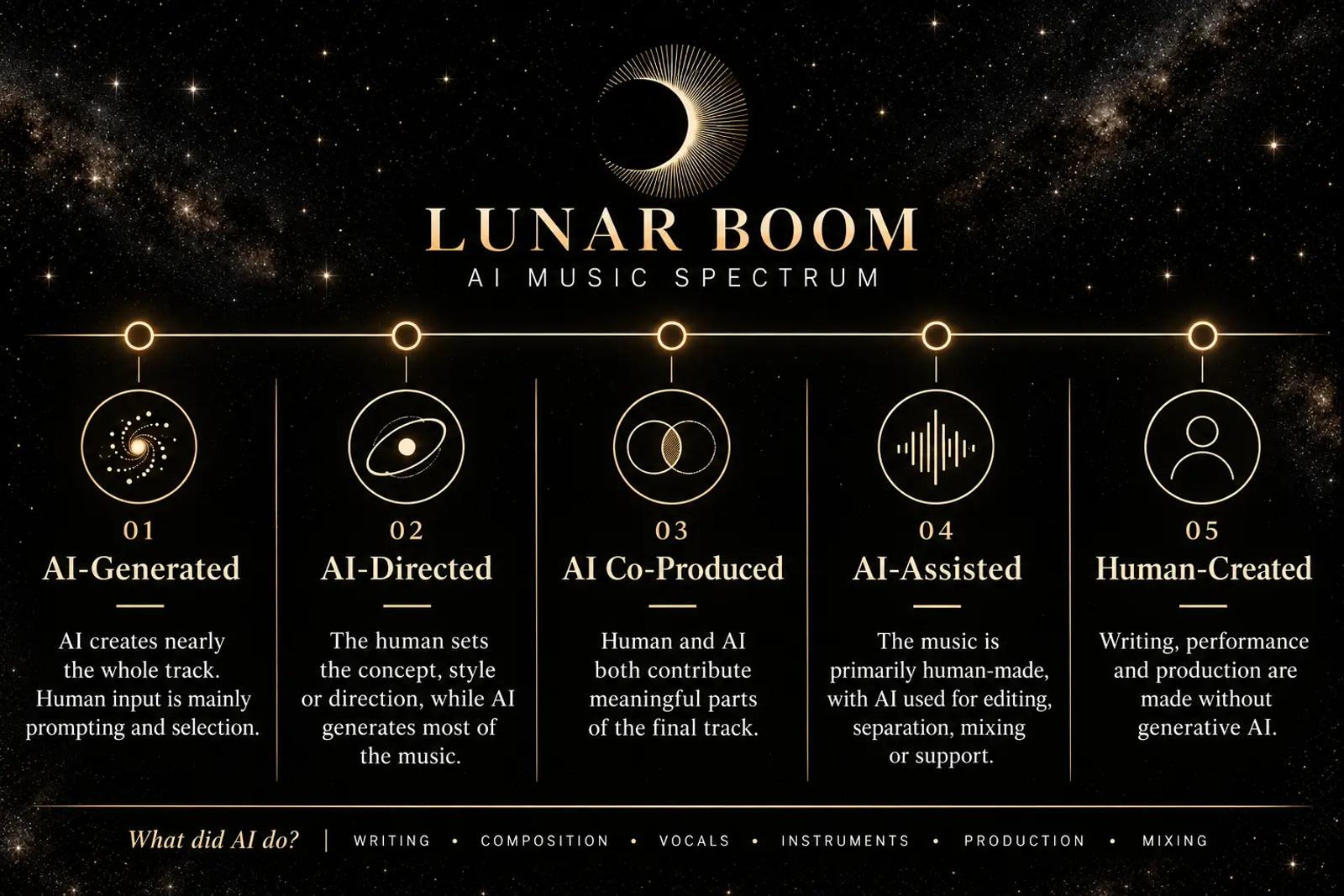
To describe that middle ground more clearly, we propose the Lunar Boom AI Music Spectrum.
The framework places music across five broad categories based on how much generative AI contributes to the finished work and where creative responsibility primarily sits.
AI-Generated sits at one end. AI creates nearly the entire track, while human involvement mainly consists of prompting, generating alternatives and selecting the preferred result.
AI-Directed describes music where AI still generates most of what the listener hears, but the person behind it provides substantial creative direction. That could include writing lyrics, developing the concept, repeatedly changing arrangements, directing style and making detailed editing decisions.
In the middle sits AI Co-Produced. Here, human creation and generative output both provide meaningful parts of the finished recording. An artist might record the vocals and instruments while generating a chorus, or write and perform most of the track while using AI for several important musical layers.
AI-Assisted moves closer to conventional production. The song itself remains primarily human-created, while AI supports specific tasks such as editing, separation, production or mixing.
Finally, Human-Created describes music where the writing, performance and production are completed without generative AI.
These categories are not intended as legal definitions or rigid boundaries. They are a descriptive framework for understanding a production environment that increasingly resists simple classification.
The most interesting music may sit in the middle
The easiest ends of the spectrum are relatively straightforward.
A song generated almost entirely from a prompt clearly involves generative AI at its core. A recording written, performed and produced without generative systems clearly sits at the other end.
The harder cases are increasingly everything between them.
Consider the artist who writes and performs an entire song but generates its main instrumental hook. Generative AI may only account for a small percentage of the recording by duration, yet that hook could be the most recognizable part of the song.
Calling the track fully AI-generated would exaggerate the role of the technology. Calling it entirely human-created would ignore an important creative contribution.
The same ambiguity appears when AI generates the singer but not the song. A person might write every lyric, compose the melody, determine the arrangement and spend hours directing different vocal generations. The audible performer is synthetic, but much of the authorship remains human.
A spectrum does not eliminate these judgment calls. It makes them visible.
How much AI was used is only half the question
There is another limitation to any single classification.
Two songs can occupy roughly the same place on the spectrum while using AI for completely different purposes.
One artist might use AI exclusively for vocals. Another might sing everything themselves but generate instrumentation. A third could use generative systems for composition while performing the resulting music conventionally.
This is why the second part of the Lunar Boom framework asks a simpler question.
What did AI do?
The poster identifies several areas where AI can participate, including writing, composition, vocals, instruments, production and mixing.
A more informative disclosure could therefore describe a song as AI Co-Produced with AI used for vocals and composition. Another could be AI-Assisted with AI used only during production and mixing.
This provides more information than attaching the same AI label to both tracks.
Music platforms are already confronting this problem
The major platforms are beginning to move in this direction, although their approaches show how difficult the classification problem has become.
In September 2025, Spotify said AI use in music should be understood as a spectrum rather than a binary. The company announced support for an industry disclosure standard developed through DDEX that can identify where AI was used, including vocals, instrumentation and post-production.
Spotify's reasoning is notable because it moves away from asking whether a song simply is or is not AI. Instead, it treats AI involvement as something that can occur within individual parts of a production.
YouTube has taken a related but somewhat different approach.
In October 2026, YouTube Music began rolling out visible labels for music where generative AI played a significant role. Behind that consumer-facing label, YouTube's delivery system allows music partners to classify tracks as fully generative AI, partly generative AI or containing no generative AI.
YouTube even gives examples of the middle category. A musician who generates a bassline or string section but records their own vocals and instruments can be classified as partly generative. The same can apply to someone who uses AI to co-write verses or develop melodies before recording the song conventionally.
The underlying metadata is therefore already more nuanced than a simple AI or non-AI divide.
The challenge is how much of that nuance reaches listeners.
Simple labels solve one problem and create another
Platforms have good reasons to simplify information.
Most listeners do not want to inspect a production ledger before pressing play. A clear disclosure can provide transparency without turning a streaming interface into technical documentation.
But simplification can also change how people interpret the music.
A prominent AI label may imply that AI created the entire work even when the technology contributed only one component. Two songs with radically different human contributions can therefore appear similar from the listener's perspective.
This becomes more consequential as AI adoption grows.
If generative tools become common inside digital audio workstations, mastering software and production platforms, simply identifying the presence of AI will reveal progressively less about how a recording was created.
The industry may eventually need disclosure systems that answer two separate questions.
How extensively did AI contribute to the track?
And what did it actually do?
Music production is becoming mixed
AI music is sometimes discussed as though two parallel industries are developing. One contains human musicians and the other contains machines generating songs.
The emerging production environment looks less clean.
Human writing can sit beside generated vocals. Live instruments can sit beside generated arrangements. Conventional recordings can pass through AI editing, while largely generated songs can contain lyrics, samples or performances created directly by people.
Production tools themselves are also becoming more integrated. Generative features are increasingly appearing alongside conventional editing tools rather than existing only inside standalone text-to-music platforms.
That makes the middle of the spectrum particularly important.
We expect more music to combine human and generative processes as these tools become easier to use. They may reduce the time required to test arrangements, experiment with unfamiliar sounds or complete production tasks that previously required additional people, software or studio time.
They may also improve some outputs by making experimentation cheaper. More attempts do not guarantee better music, but they can give creators more opportunities to find an arrangement or performance that works.
Labels should describe the process
Transparency around AI music is useful. Listeners should be able to understand when generative systems played a meaningful role in something they are hearing.
But transparency becomes less useful when it collapses very different processes into the same category.
The Lunar Boom AI Music Spectrum is one attempt to create better language for that middle ground. It does not try to determine whether using AI makes a song more or less artistic, and it does not assume that every workflow can be classified perfectly.
Its purpose is simpler.
AI-Generated, AI-Directed, AI Co-Produced, AI-Assisted and Human-Created describe different relationships between people and generative systems. Adding information about whether AI contributed to writing, composition, vocals, instruments, production or mixing makes those relationships clearer still.
As AI becomes more integrated into music production, the question of whether a song is AI music may become increasingly difficult to answer and increasingly unhelpful to ask.
The better questions are how AI was used, where it entered the process and how much of the finished work it shaped.
The future of music may not sit on either side of an AI label.
Much of it may live somewhere in between.