Oliver, who releases music as imOliver, emerged from the early wave of artists building music directly through generative platforms. His track Stone gained substantial traction on Suno before reaching traditional streaming services, and his work later led to an agreement with Hallwood Media.
That trajectory makes his experience particularly useful for understanding what happens after an AI-generated song finds an audience. Oliver has already confronted questions around monetization, audience ownership, changing generation models and the role a record label can still play when producing music has become much easier.
His experience suggests that AI is changing the production side of music faster than the economic and institutional systems surrounding artists. Making the record is becoming easier. Turning that record into a sustainable career remains a different problem.
When production becomes easier, taste becomes the job
Oliver describes himself as a “music designer,” a term he says Hallwood founder Neil Jacobson coined.
He prefers it to labels such as “AI musician” or “prompter” because they place too much emphasis on the technology. In his view, when generative tools remove much of the traditional friction involved in producing music, the creator becomes increasingly responsible for deciding what is actually worth keeping.
“When you remove the traditional friction of making music, what are you left with? Taste.”
This idea has appeared repeatedly across our conversations with people making music with AI. In AI Music and the New Burden of Choice, Vitalii Klimenko described how generation creates options while production still requires decisions. Brian Myk similarly discussed the growing importance of judgment in What Skills Should Artists Value in the Age of AI Music?.
Oliver takes that argument further by treating taste as one of the defining skills of an AI-native creative process.
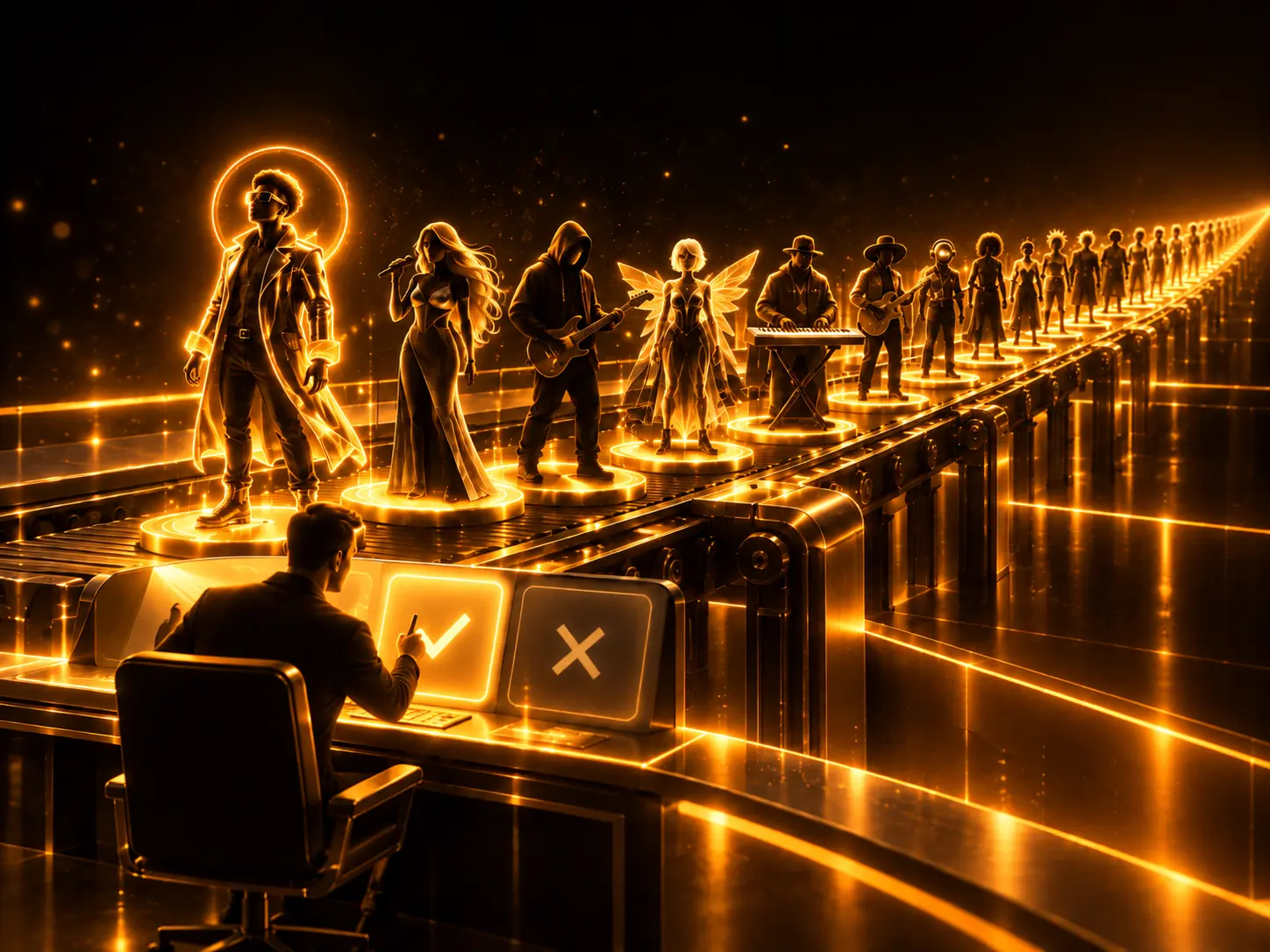
“Having great taste in music is about having the courage to say no to a thousand good songs so you can find the one that is truly great.”
When many plausible songs can be generated quickly, simply producing another one becomes less distinctive. The difficult part is deciding which song deserves to represent the artist and which of the many good possibilities should never be released.
A breakout song does not automatically create a portable audience
Stone first gained momentum inside Suno rather than through the traditional streaming ecosystem.
For Oliver, that exposed a weakness in the relationship between AI platforms and the artists emerging from them.
“Trying to move listeners from an AI platform to traditional streaming is like trying to push water uphill.”
Suno began primarily as a generation service, but Oliver's experience shows how that definition becomes harder to maintain once artists build audiences and songs gain traction inside the platform itself. If creation, discovery and community begin to overlap, questions about creator compensation naturally follow.
Oliver believes those platforms need to think beyond giving users access to a model.
“If you aren't compensating the creators who make your platform successful, you don't have a future. It's that simple.”
His argument is not simply that creators should receive a small payment for generating engagement. He wants AI music platforms to support the foundations of an actual creator economy, with royalties, licensing, subscriptions and other ways for successful creators to earn a living from the value they provide.
The creator economy question is also about loyalty
Oliver's frustration with Suno is not only financial.
He believes some AI music companies are becoming increasingly focused on attracting established musicians while giving less attention to the creators who adopted the technology early and helped build communities around it.
“The biggest creators on Suno are being sidelined while the company chases after ‘real’ musicians.”
His criticism reflects a broader tension over who these platforms are ultimately being designed to serve.
For an established musician, an AI platform may primarily be another production tool. For someone whose audience, songs and creative identity first developed inside an AI platform, expectations can be much broader.
The platform may simultaneously function as a studio, community, discovery channel and place where an artist first develops an audience. Oliver's argument is that the economic relationship should evolve when the platform begins performing all of those roles.
He points to ElevenMusic as closer to the kind of commercial structure he would like to see.
“It’s royalties, it’s licensing, it’s subscriptions, it’s the ability to earn a living from the value you provide.”
If AI platforms want creators to build careers around them, Oliver believes those careers need an economic foundation rather than relying only on access to increasingly capable generation models.
The artist should survive the model
Oliver has also begun working with ElevenMusic after much of imOliver's early success came through Suno.
Changing systems required him to adjust his writing and prompting because different models respond differently. He does not, however, see the generation model as the thing that defines imOliver.
“I heard amazing beats played on buckets. It’s not about the tool, it’s about the person using it.”
The technology changed, but Oliver says the themes, selection process and taste remained consistent.
That raises an important question for AI music as the available models multiply. If an artist can move between different generation systems without losing their identity, the model begins to look less like the artist and more like one part of the production environment.
Oliver expects the major systems to become more similar over time. Whether that happens remains uncertain, but his broader point does not depend on every model becoming identical.
An artist's identity can sit above the technology.
The prompts may change. The voices may change. The model may change. The decisions connecting those outputs into a recognizable body of work can remain with the creator.
Why an AI artist still wanted a record label
Oliver's agreement with Hallwood complicates another common assumption about AI music.
Generative tools can reduce the cost of producing music and allow creators to reach listeners without the recording infrastructure traditionally associated with a label. Oliver had already demonstrated audience demand before entering his agreement with Hallwood.
He still saw a reason to work with one.
“My only reason for working with a label was protection.”
Oliver is describing his reason for entering the relationship, rather than everything Hallwood may contribute to his career. What he wanted most was institutional support in an environment where copyright questions, platform policies and disputes involving AI-generated music remain difficult for an independent creator to navigate.
“If there's a dispute, the platforms listen to the labels. For an independent, it's the Wild West out there.”
His experience suggests that AI may reduce the importance of some traditional label functions without making the label itself irrelevant.
An artist may need less outside capital to produce a recording, while still valuing legal expertise, rights management, licensing relationships and leverage with streaming platforms. The role of the label can change even if the institution remains important.
AI is moving the bottlenecks
Oliver's experience fits a broader pattern appearing throughout our interviews.
Generative AI removes one constraint and makes another more visible.
Producing music becomes easier, so selection becomes more important. Distribution becomes more accessible, while attention becomes harder to retain. Artists can create more independently, but rights management and institutional leverage remain difficult to reproduce alone.
Oliver adds the economic relationship with the generation platform itself.
An artist can create a breakout song, attract an audience and contribute to the culture of an AI platform without necessarily having a clear path for turning that success into recurring income.
The production problem may be shrinking faster than the career problem.
AI may rearrange the music industry rather than remove it
There is a simple version of the AI music story in which cheaper production gradually removes intermediaries.
Oliver's experience suggests something less linear.
AI platforms can become more important because they are where music is created and discovered. Record labels can remain relevant because legal and commercial infrastructure does not disappear when recording becomes cheaper. Artists can move between generation models while treating taste and identity as the things that actually belong to them.
Those changes point toward a music industry where some old functions become less valuable and others become more important.
The artist may no longer need the same infrastructure to create the song. They still need a way to build an audience, earn from that audience, protect their work and maintain an identity as the underlying technology changes.
Generative AI can make producing music easier.
Building a career around that music still requires much more than generation.
Oliver's experience with Stone, Suno, ElevenMusic and Hallwood shows how quickly those questions are moving from theory into practice. The technology has already changed what it takes to make the record.
The next challenge is building an industry around the people who make something worth listening to.
Explore imOliver
You can follow Oliver's music, releases and writing through imOliver.com.