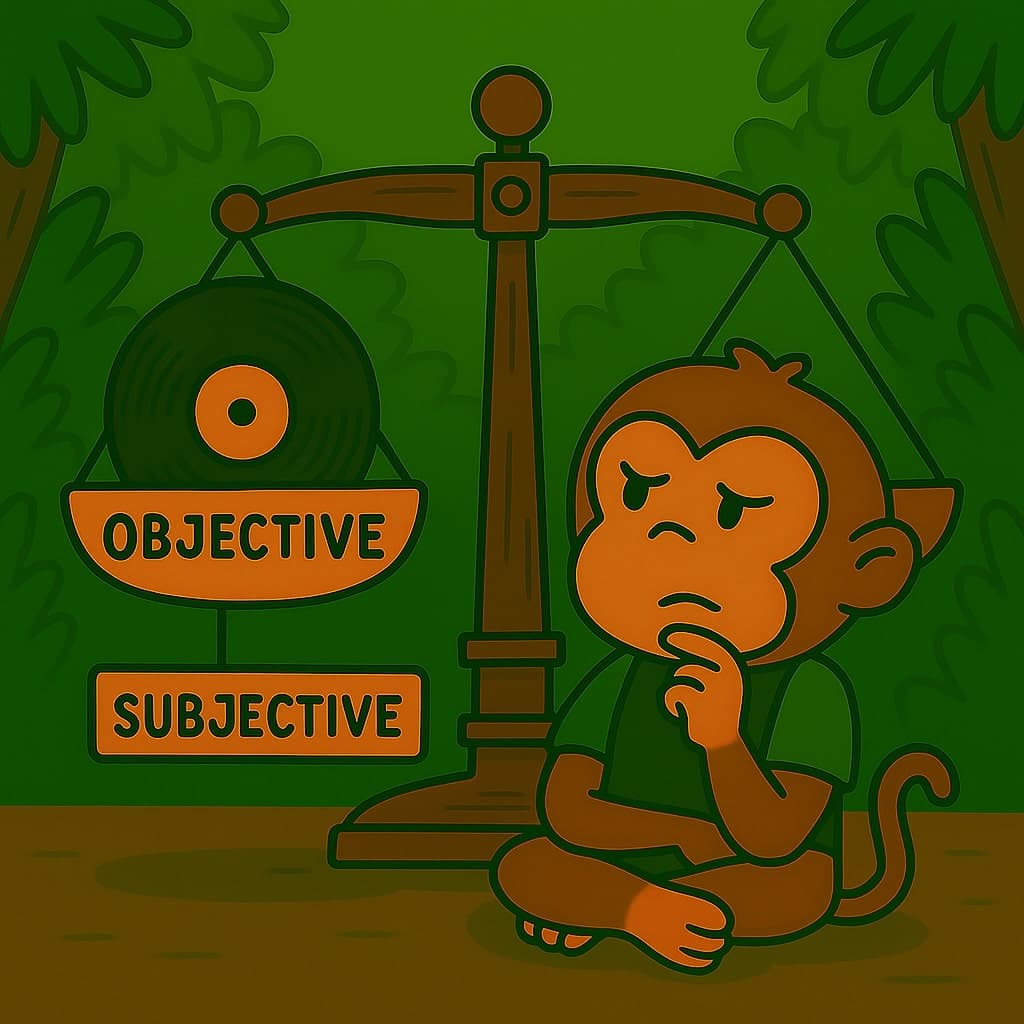
Music can be valuable because it performs a function or because a listener cares deeply about the artist and meaning behind it. The distinction between objective value and subjective value is useful for thinking about AI music, as long as the terms are treated as a framework rather than a claim that musical value can be measured perfectly.
Objective value describes practical usefulness
In this framework, objective value comes from qualities that make a track useful in a setting. Stable melodies, clean tones, predictable structures, and limited vocal distraction can work well for cafés, studying, meditation, wellness, or background listening.
This instrumental track is the source's example of music whose value comes heavily from fitting a nature-oriented setting.
That does not mean the track lacks artistry. It means much of its usefulness can be judged by how well it performs the intended role.
Subjective value comes from identity and meaning
Subjective value depends more on the listener's relationship with the music.
Artist identity, emotional expression, story, lived experience, and cultural context can make one recording matter more than another even when both are technically competent. The source points to artists such as Kanye West, Taylor Swift, The Weeknd, Billie Eilish, and Lana Del Rey as examples of music whose value extends beyond the sound file.
This emotional track is used as an example of vocal expression and narrative carrying more of the value.
Most music contains both dimensions. A background track can become personally meaningful, while a famous artist still needs music that works on a basic musical level.
AI increases the supply of functional music
Tools such as Suno and Udio can produce study beats, ambient pads, background loops, instrumentals, and chill-house material quickly.
That makes AI especially relevant where the user already knows the function they need the music to perform.
As this type of music becomes easier to produce, technical competence alone may become less distinctive. The harder part is deciding what is worth releasing and how it fits a specific use.
AI artists test whether identity can also be synthetic
The source argues that anonymous systems have a harder time creating the kind of long-term attachment listeners form around human artists.
AI artist projects complicate that idea because they can add names, visual identities, catalogues, and recurring styles around generated music. Lunar Boom collects examples through its AI Music Artists section.
The open question is whether listeners value those identities in the same way they value human artists. Better generation can increase the supply of useful sound, but identity and meaning require something more than producing another technically competent track.